Find the place. Grow the life.
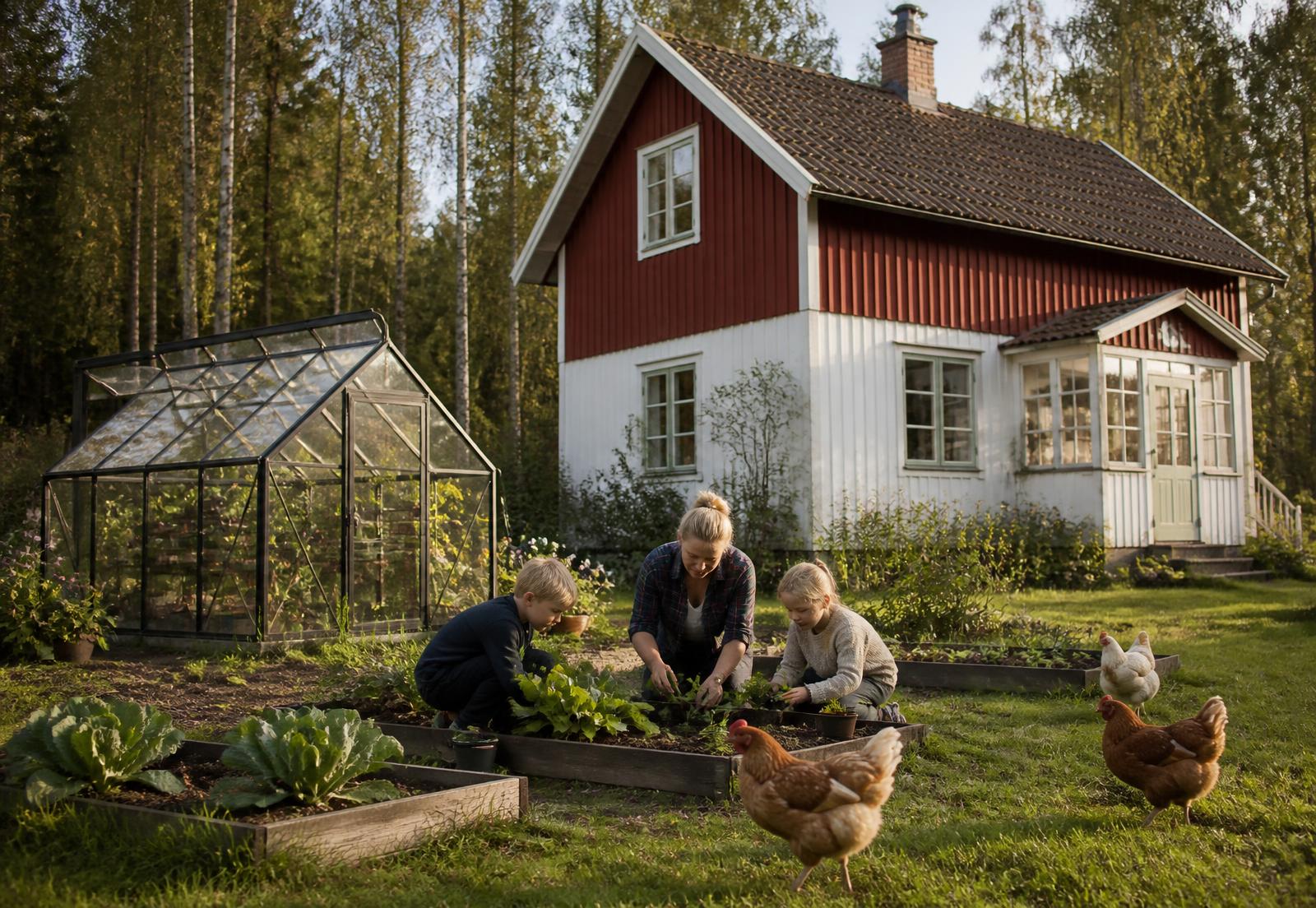
Your family on land of your own — planned properly, anywhere in the world.
Plan Our Life turns the dream into a costed, country-by-country plan: where to buy, what it really costs, and how much land you'll need to feed your household. Free to start. No spreadsheet required.
All Nordic countries · 19+ regions worldwide · Any currency · Metric or imperial · Data from USDA, FAO, SLU, Luke, NIBIO and national agencies
What you walk away with
Stop guessing what land costs
Compare land prices, cost of living and residency rules across countries side by side, so you know where your money actually buys the life you want.
Know if you can feed yourselves
See the land area, work hours and cost per person for an omnivore, vegetarian or vegan household — per day, month and year.
Buy the right place the first time
Walk into every viewing with a checklist built from your own goals instead of a feeling you can't defend.
From idea to plan in four steps
Most families finish the first pass in an evening — and finally have something concrete to decide from.
- Step 1
Tell us where you stand
Budget, household, skills and how much time you really have each week. Ten minutes, no spreadsheets.
- Step 2
Get your land brief
Exactly how many hectares or acres, which buildings and which climate zone fit your goals — in any country you're considering.
- Step 3
See the real numbers
Purchase, renovation, running costs and food self-sufficiency, in your currency and units. Before you fall in love with a listing.
- Step 4
Follow a plan that holds
A year-by-year build-up of growing, animals and income, paced so the family stays intact.
Try it now
How much land would you need?
Adjust your household, diet and how much of your food you want to grow yourself. This is the same calculation that powers the full planner.
A mixed diet in line with the Nordic nutrition recommendations.
Your preview estimate
Planning-grade numbers for a 2 adult, 2 child household producing 50% of its own food.
Growing land
1.16 hectares
Crops + any animals required
Time per week
13 h
Average across the year
Food per year
876 kg
Of the 50% you grow
Estimated savings
€18,464
Per year, if successful
This is just the food part. A full plan also includes purchase costs, running costs, the right climate zone and a year-by-year timeline.
And what would you actually grow?
Pick the climate closest to the place you're considering and see the crops that carry a self-sufficient year there — when to sow, when to plant out and when you harvest.
The classic four-season smallholding year: sow under cover in spring, harvest heavily from July, store from September. Main season roughly Apr–Oct.
Roots and tubers
The calorie base of a self-sufficient year and the easiest crops to store without electricity.
Potatoes
Plant Mar–May · Harvest Jul–Sep
Carrots and parsnips
Sow Apr–Jul · Harvest Jul–Oct
Beetroot and swede
Sow Apr–Jul · Harvest Jul–Oct
Onions and garlic
Plant Mar–May · Harvest Jul–Sep
Vegetables and greens
Fast, repeatable sowings that carry the everyday plate through the season.
Cabbage, kale and broccoli
Sow Feb–Apr · Plant Apr–Jun · Harvest Jul–Dec
Salad and spinach
Sow Mar–Sep · Harvest Apr–Nov
Squash and pumpkin
Sow Mar–Apr · Plant Apr–May · Harvest Aug–Oct
Beans and peas
Protein you can dry and keep, and the crop that feeds the soil for next year.
Peas
Sow Mar–Jun · Harvest Jun–Sep
Beans (green and drying)
Sow Apr–Jun · Harvest Jul–Oct
Grain and staples
Needs area rather than attention: sown once, harvested once, stored dry.
Wheat, rye and oats
Sow Mar–May · Harvest Aug–Oct
Maize and sorghum
Sow Apr–Jun · Harvest Aug–Oct
Fruit and berries
Planted in the dormant season and harvested for decades afterwards.
Fruit trees
Plant Oct–Jan · Harvest Aug–Nov
Berry bushes and canes
Plant Oct–Jan · Harvest Jun–Sep
Warmth-loving crops
Tomatoes, cucumbers and peppers – started early indoors, finished under cover in cool zones.
Tomatoes and peppers
Sow Jan–Mar · Plant Apr–May · Harvest Jul–Oct
Cucumber and courgette
Sow Mar–Apr · Plant Apr–May · Harvest Jun–Sep
Planning estimates based on months around the last spring frost — your own frost dates, soil and varieties shift them by weeks. The full planner builds a month-by-month calendar for your exact place.
Land ownership rules
Are you even allowed to own it?
In South Korea farmland may only be bought by someone who will farm it, and you file a cultivation plan to get the title. Norway can require you to move in and keep the fields in production. Denmark asks for five years of residence. Greenland does not sell land at all. We keep a plain-language taste of the rules — foreign buyers, duty to farm, permits, residency and subdivision — for every country we cover.
See the rules by countryForeign buyers
Who may hold title, and for how long
Duty to farm
Where the land must stay in production
Acquisition permits
Consents and pre-emption rights
Residency duty
Where you must actually live there
We won't promise you an easy life on land. We'll show you, in numbers, exactly what it takes to make it work.
- Covers the whole Nordics
- Your currency, your units
- Backed by official data
- Paced to be sustainable
What your first plan looks like
An illustrative example — yours is built from your own answers, budget and location.
- Today
- Family of four renting in a city
- Budget
- Mid-range, one income kept during the move
- Land brief
- 2–5 hectares (5–12 acres), water access, workable outbuilding
- Goals
- Kitchen garden, fruit, berries and laying hens
- Time available
- 12 hours per week
- Plan
- Growing in year 1, animals in year 2, income shift in year 3
- Best value regions
- 3 countries shortlisted on land price and residency rules
Our sources
Guidelines, figures and recommendations in Plan Our Life are based on public and research-based sources. Choose your region to see the ones that apply where you live.
- Food and Agriculture Organization of the United Nations (FAO)
Global policy, standards, data and technical manuals, including urban and peri-urban agriculture.
- CGIAR
International research consortium on germplasm and climate-smart practices.
- International Plant Protection Convention (IPPC)
Phytosanitary standards and pest risk analysis.
Browse the full source library · How we calculate
These sources are used as background knowledge. Plan Our Life is not affiliated with, or reviewed by, these organisations.